
Studios & publishers
Every studio and publisher on Steam: how many games they released, how many reached 500 reviews, what a typical game of theirs gets and what they are making now. A company opens its own page with its games one by one, its current projects and how it launches.
Open Studios & publishers →Catalogue
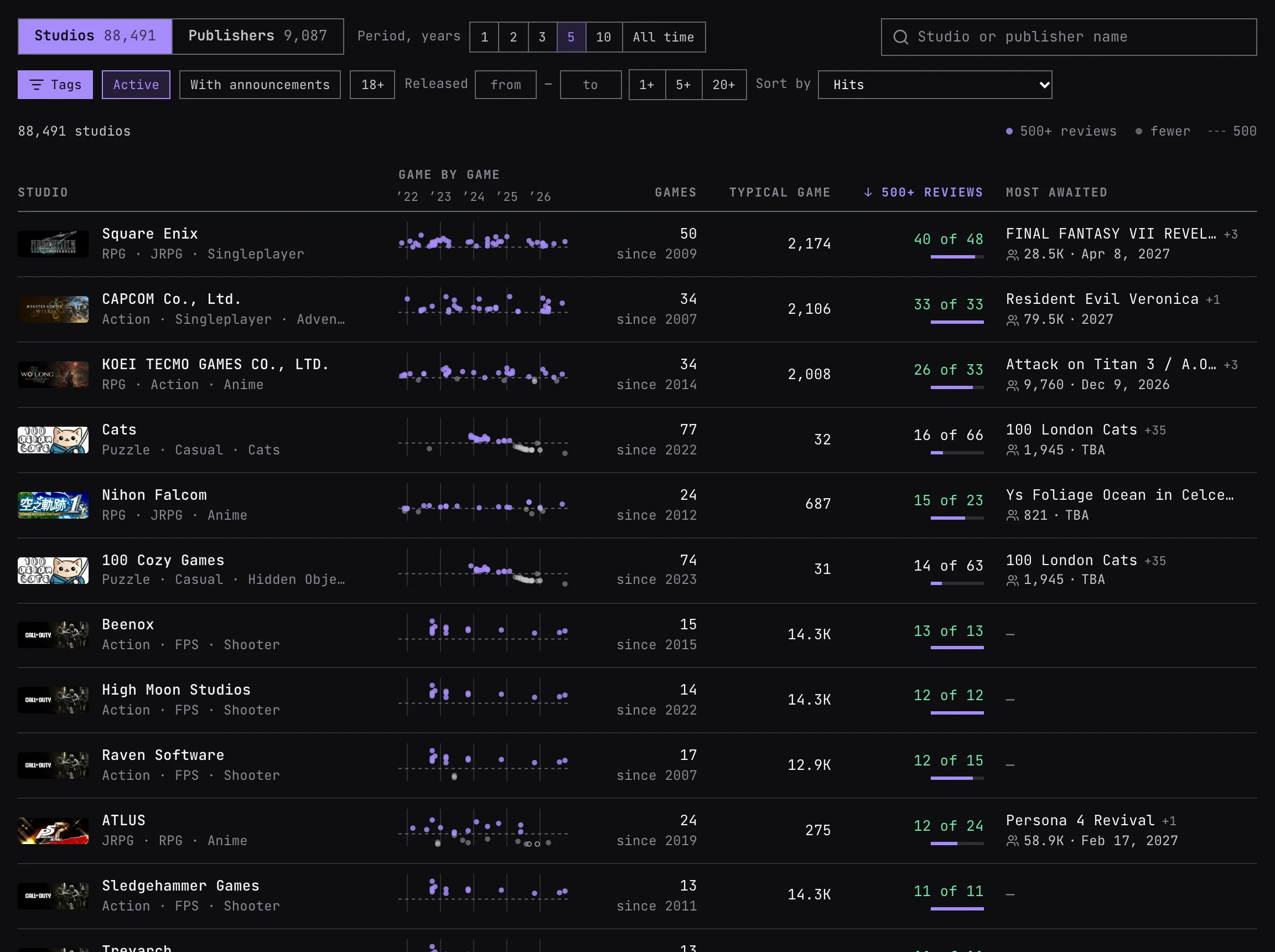
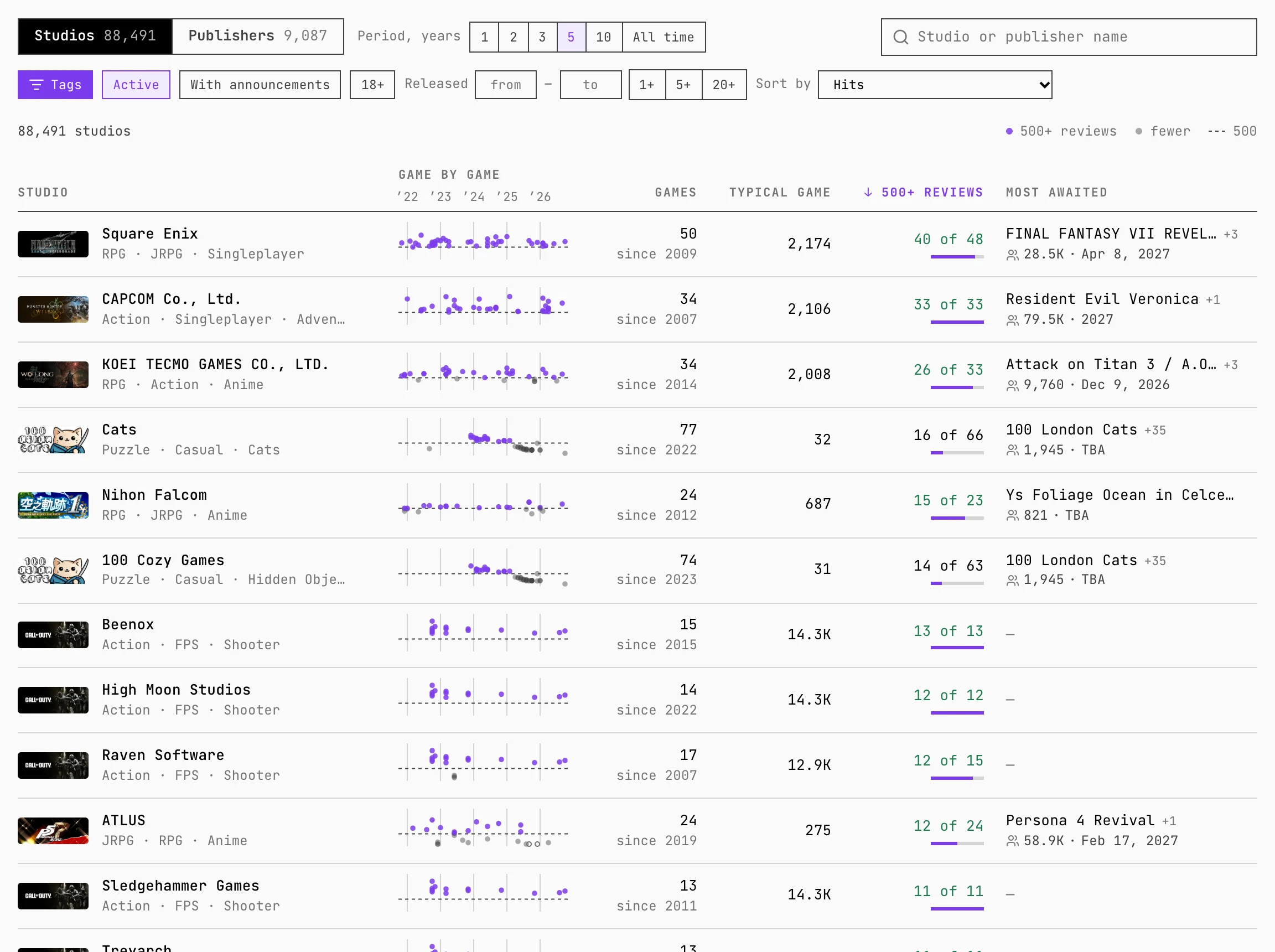
- Studios or Publishers. Two tabs, each with the number of companies that match the filters. A publisher’s numbers count only the games it published for other studios.
- Period. 1, 2, 3, 5 or 10 years, or All time; 5 by default. Games, hits, the typical game and the dots are counted over the games released in it. A company is listed if it released something in the period or has a game announced.
- Filters. Search by name; tag, with the same picker as in Explore, where a tag includes everything under it in the Tag Tree; Active, on by default: a release in the last two years or a game announced; With announcements; 18+, hidden by default; and the number of released games, from and to. The link keeps them.
- Game by game — one dot per released game: release date across, reviews up on a log scale, the same scale in every row. Dots above the dashed line reached 500 reviews. Hover for the game, click to open it.
- Columns. Games released in the period. Typical game: the median of lifetime reviews. 500+ reviews reads “3 of 7” among the games out for 90 days or more, and “too early” when none is. Positive: the share of positive reviews across games with 50 or more reviews. Most awaited: the announced game with the most followers. Publishers add Signed: games by other studios that took them as publisher in the last 12 months.
- Sort by any column, Hits by default; a second click reverses the order. Fifty companies to a page.
Company page
Opens from the catalogue and from the studio and publisher names in the header of a game page.
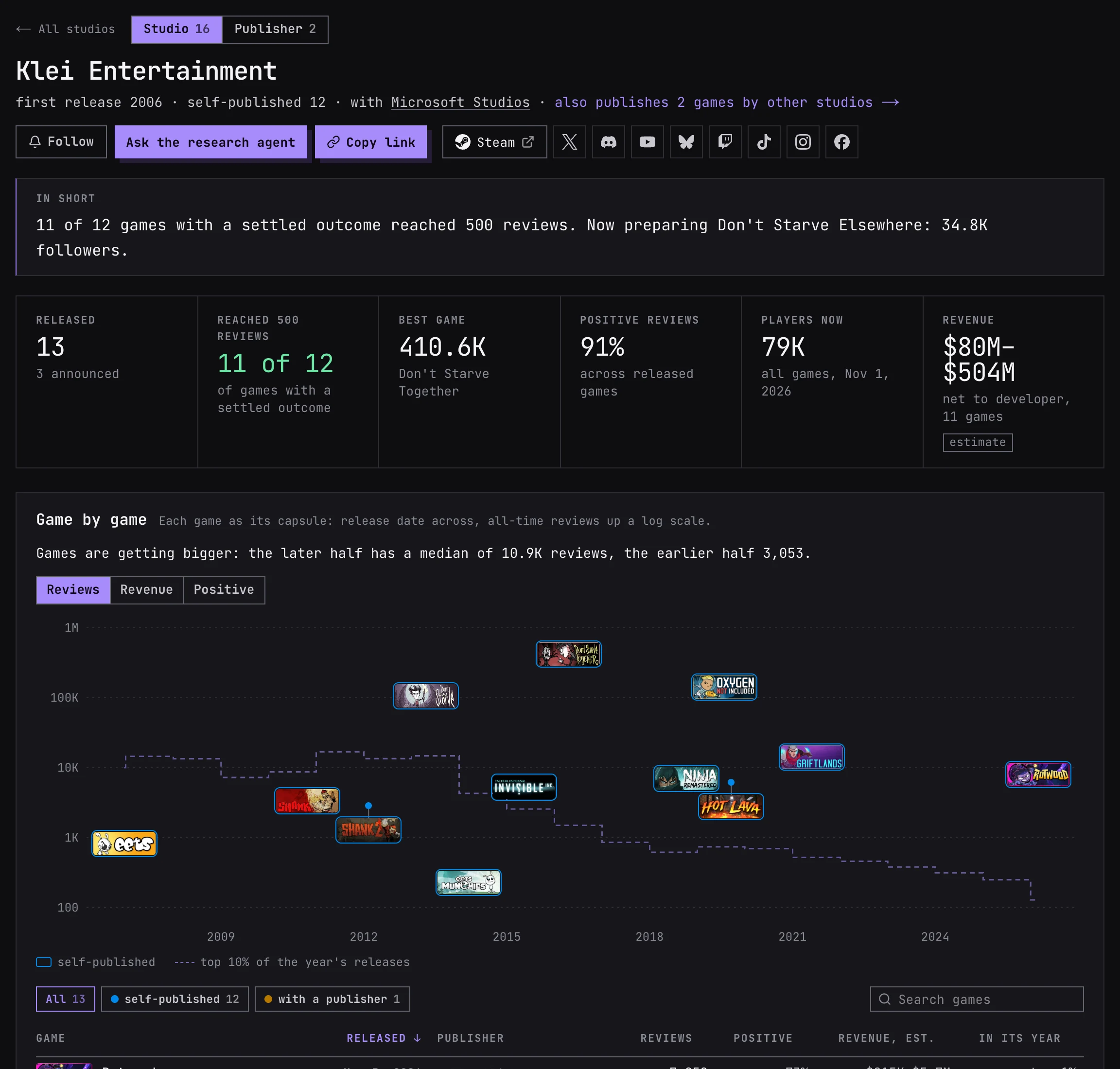
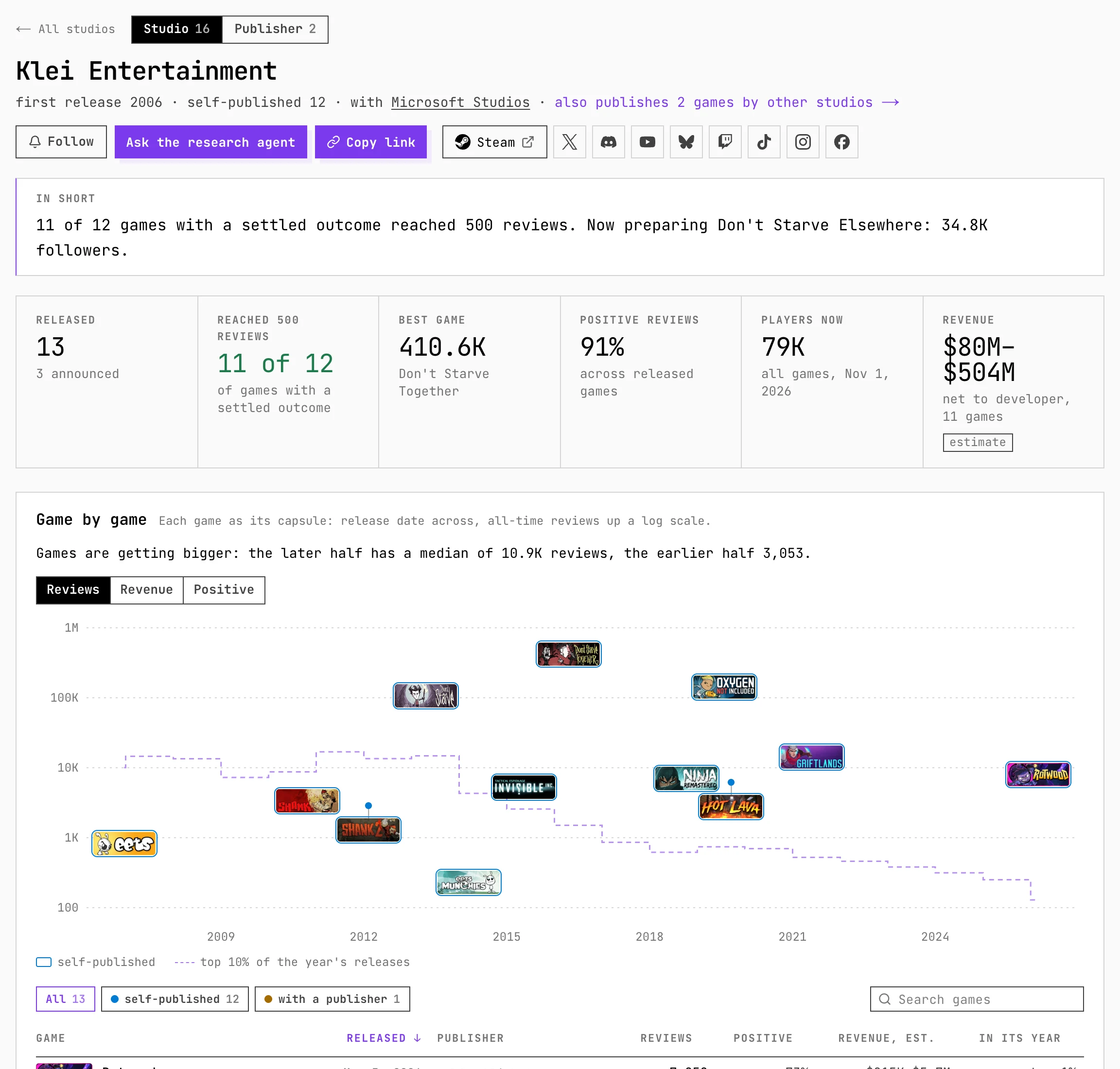
- Head. The name, the year of the first release, links to Steam and the company’s own channels. A company that both makes and publishes games has a Studio / Publisher switch. Follow sends a Telegram message when it announces a game, shows up as the publisher of one or signs a studio.
- In short and tiles. A sentence on how its games did, then released and announced games, how many reached 500 reviews, the best game, positive reviews, players right now and estimated revenue. A publisher page adds its place against publishers of the same niche, the share of releases under 10 reviews and the grade from Publishing.
- Game by game. Every released game as its capsule, by release date and reviews; the switch changes the height to revenue or the positive share. The dashed line is the top 10% of that year’s releases. The table below can be searched and sorted; In its year is the game’s place among that year’s games with the same main tag.
- What are they working on now? — announced games with the date, followers, Top Wishlists place, demo and fests, and flags such as Fast-growing, Followers stalled, Demo out 180+ days or Date moved 2+ times. On a publisher page it is What is coming and what are they signing?: announced games by other studios and new signings, dated by when the publisher appeared on the store page, not by the deal.
- How do they launch? — shown when at least two games can be compared: a demo before release, Next Fest, the time from store page to release, Early Access and updates in the first 180 days, and for each game the launch price, followers at release, reviews in the first month and the peak of week one.
- What do they do differently from self-publishing? (publishers) — demo, Next Fest, interface languages, updates and the share that reached 500 reviews, against self-published games of the same main tag and year.
- Who publishes them, What do they make (studios) — the publishers of their games and how many they published themselves, the main tags and how they changed over the years.
- Studios like this, Publishers like this — companies with the same main tags and a typical game within ×4 of this one.
- How to pitch them (publishers) — how they take submissions, with the date it was checked. Coming from the Publishing finder with your tags adds the pitch kit. Track puts the publisher on your Publishing board.
Worth knowing
- Steam lists companies by name, not by ID. Spellings that differ only in case, punctuation or a legal suffix (Inc., Ltd, GmbH) are merged, and two different companies with the same name end up on one page.
- Revenue is our estimate from reviews and price, as on game pages, shown as a range such as $1M–$10M. Free games and games under 25 reviews are left out, so the total is a lower bound.
- A game is judged 90 days after release; newer ones are listed but not counted in the shares. Publishers pick games that already look strong, so a gap against self-published games shows who they pick, not what publishing adds.
- Publishing, further down the panel, is for finding a publisher for your game: only publishers that sign outside developers, with a grade, pitch status, a finder and a board. Studios & publishers lists every company and ranks no one; a publisher’s page is the same in both.