Help
what each tool answers and how to use itPlayRecon is market intelligence for people shipping games on Steam. Every tool works on the same dataset — release dates, wishlists, chart positions, followers and reviews for 300k+ store pages, refreshed hourly. The date in the sidebar footer shows the current data snapshot.
Calendar
Answers one question: who else ships in your window. Pick any week, month, quarter or year — past or future — and see every release in it, sized by demand.
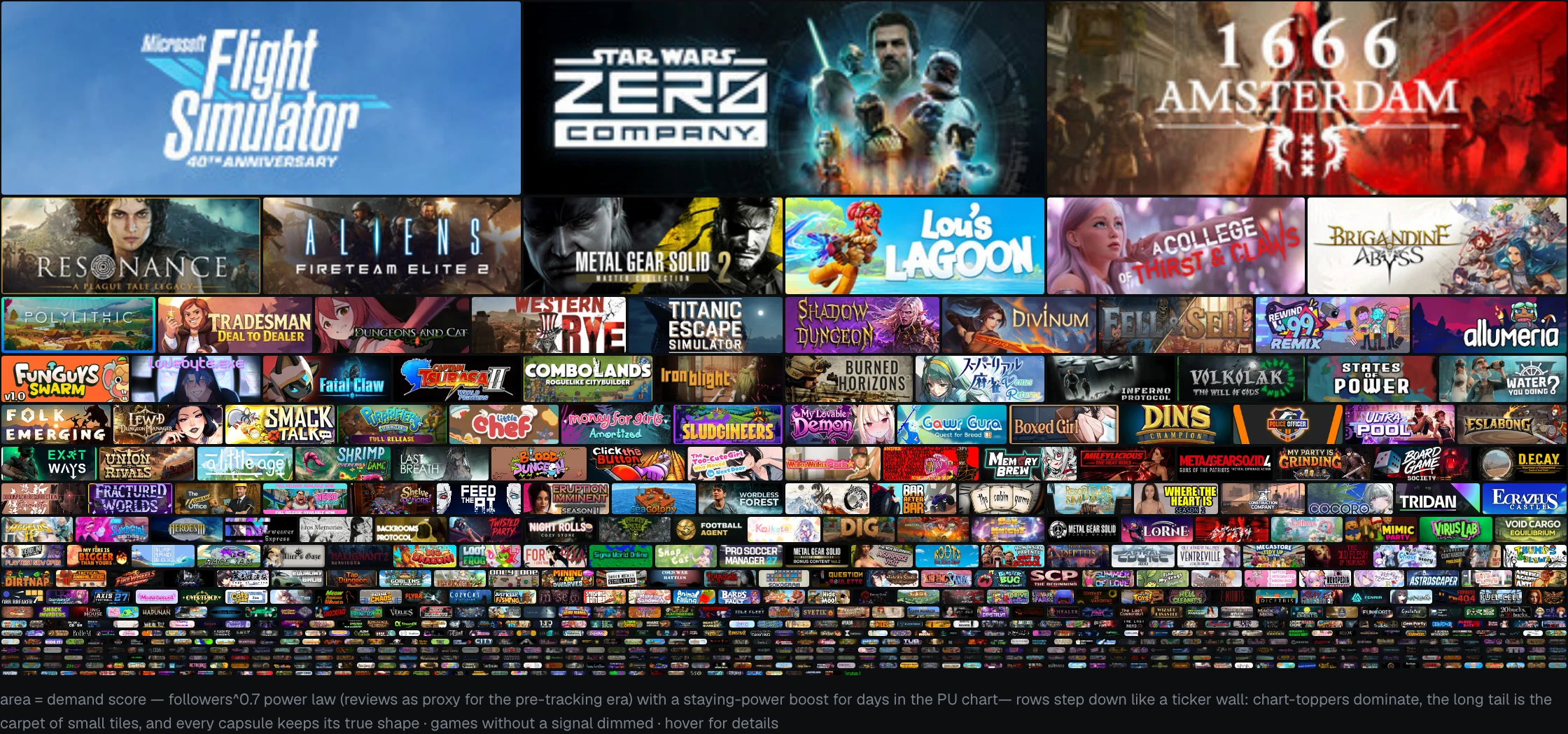
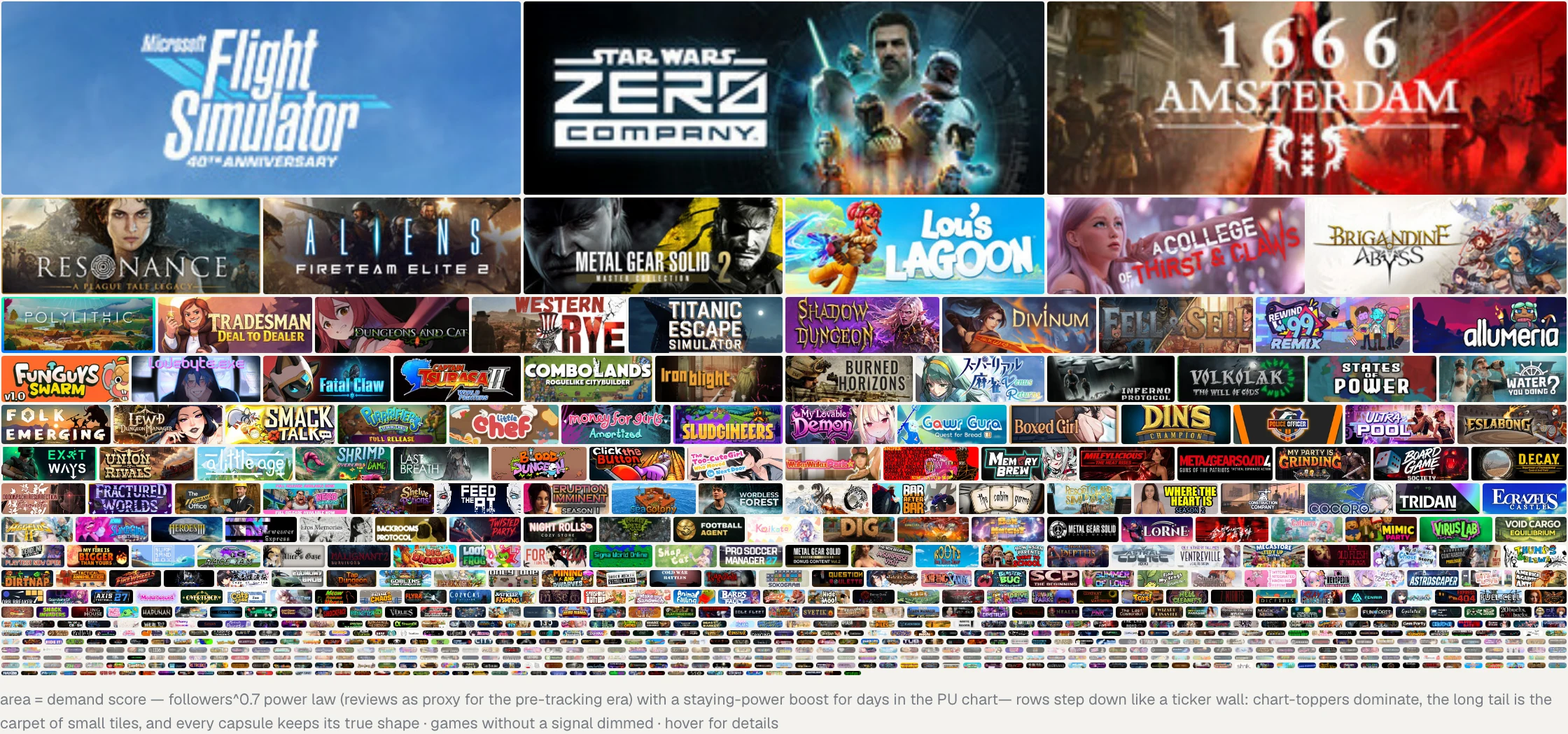
- Pick a period. Switch Weeks / Months / Quarters / Years at the top; arrows step to the previous or next period, Now returns to today. History goes back to 1997. TBA collects announced games without a date.
- Choose what tile area means. Score (default) blends followers with staying power on the Popular Upcoming chart; PU and WL size tiles purely by chart rank; Followers by community size.
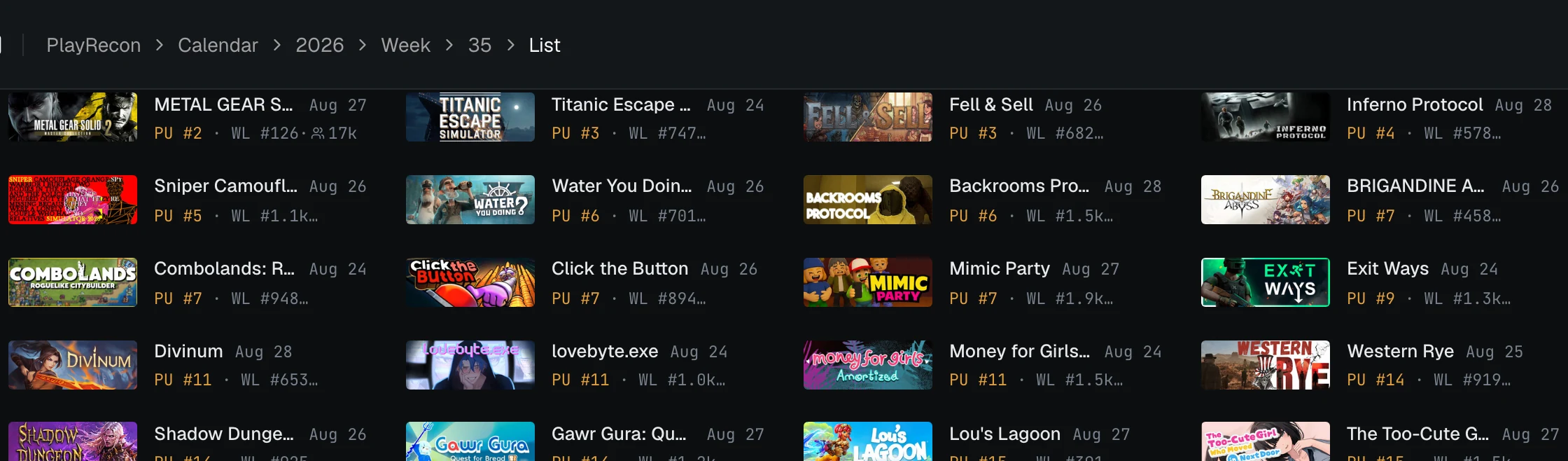
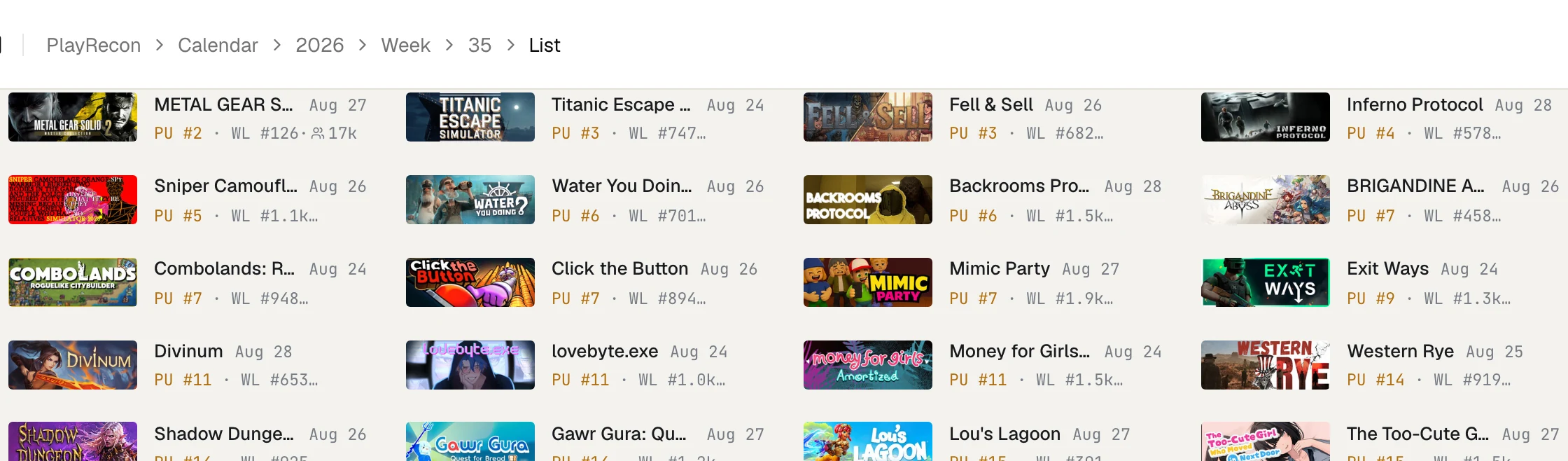
- Switch to List for a flat feed of the same games — 100 per page with peak PU rank, wishlist rank, followers, reviews and demo CCU on each card. Sort by demand, date, followers or reviews.
- Filter by tag to narrow the whole page to your genre — the filter carries across periods while you navigate.
Tiles are laid out in justified rows: every row spans the full width, all tiles in one row share the same size, and row heights step down as demand falls. Every capsule keeps Steam's exact 231:87 proportions, so nothing is cropped — a game's area stays proportional to its demand weight, quantized to its row. The weight depends on the selected tile-area metric:
| Score | (followers + 15)^0.7 × (1 + 0.3 × occupancy) | followers on a power law with a staying-power boost; games released before rank tracking substitute reviews × 3 for followers |
| PU / WL | 1 / rank^0.6 | peak chart position; PU is additionally multiplied by (1 + 0.66 × occupancy) |
| Followers | √followers + 0.35 | community size alone |
occupancy — the share of a game's runway (first Popular Upcoming appearance → release) it actually held a chart spot. It rewards staying power without punishing games that announce a precise date late.




Heatmap
Shows how crowded every shipping window has been — and which announced weeks are already filling up. Use it to find quiet windows before committing to a date.
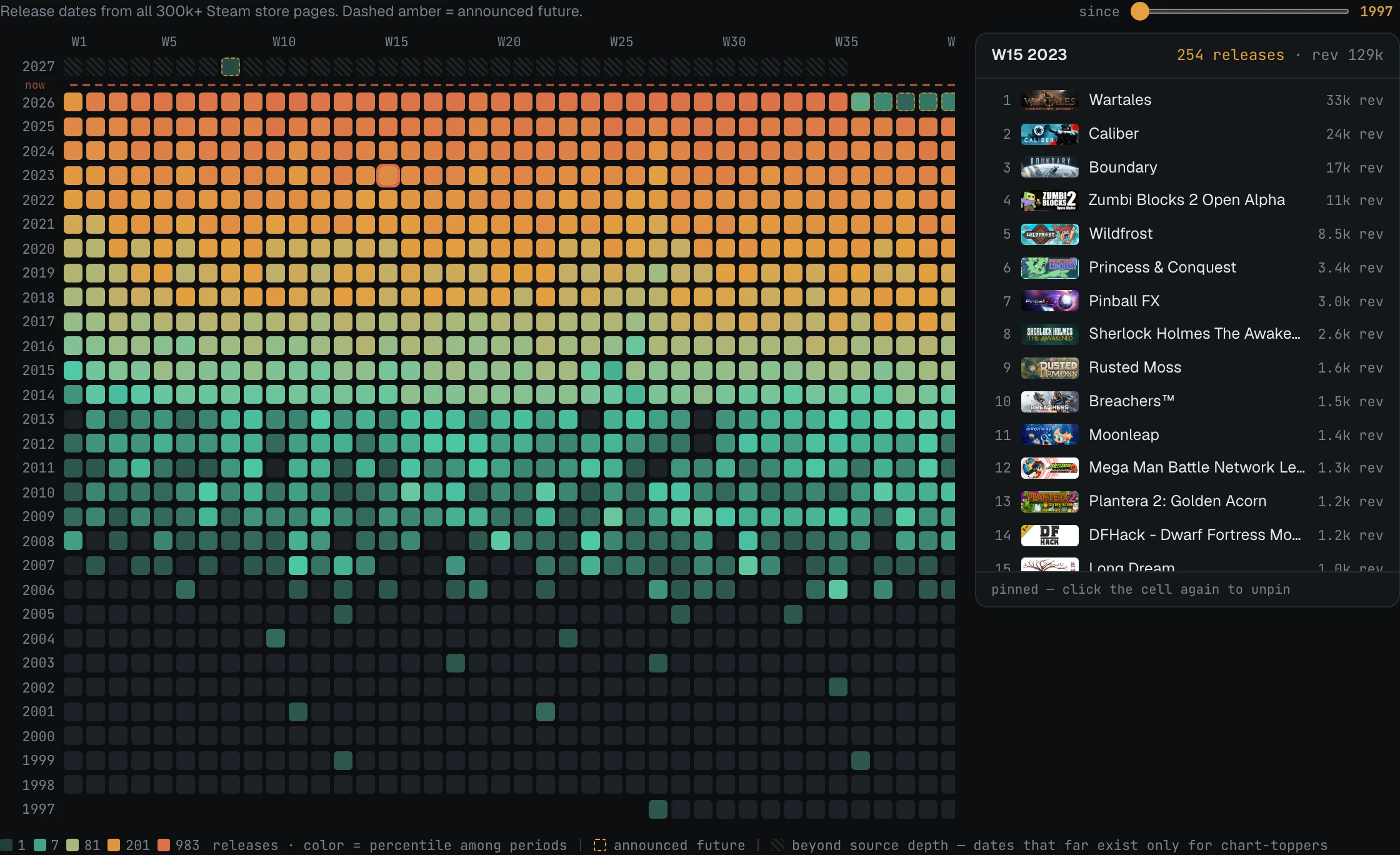
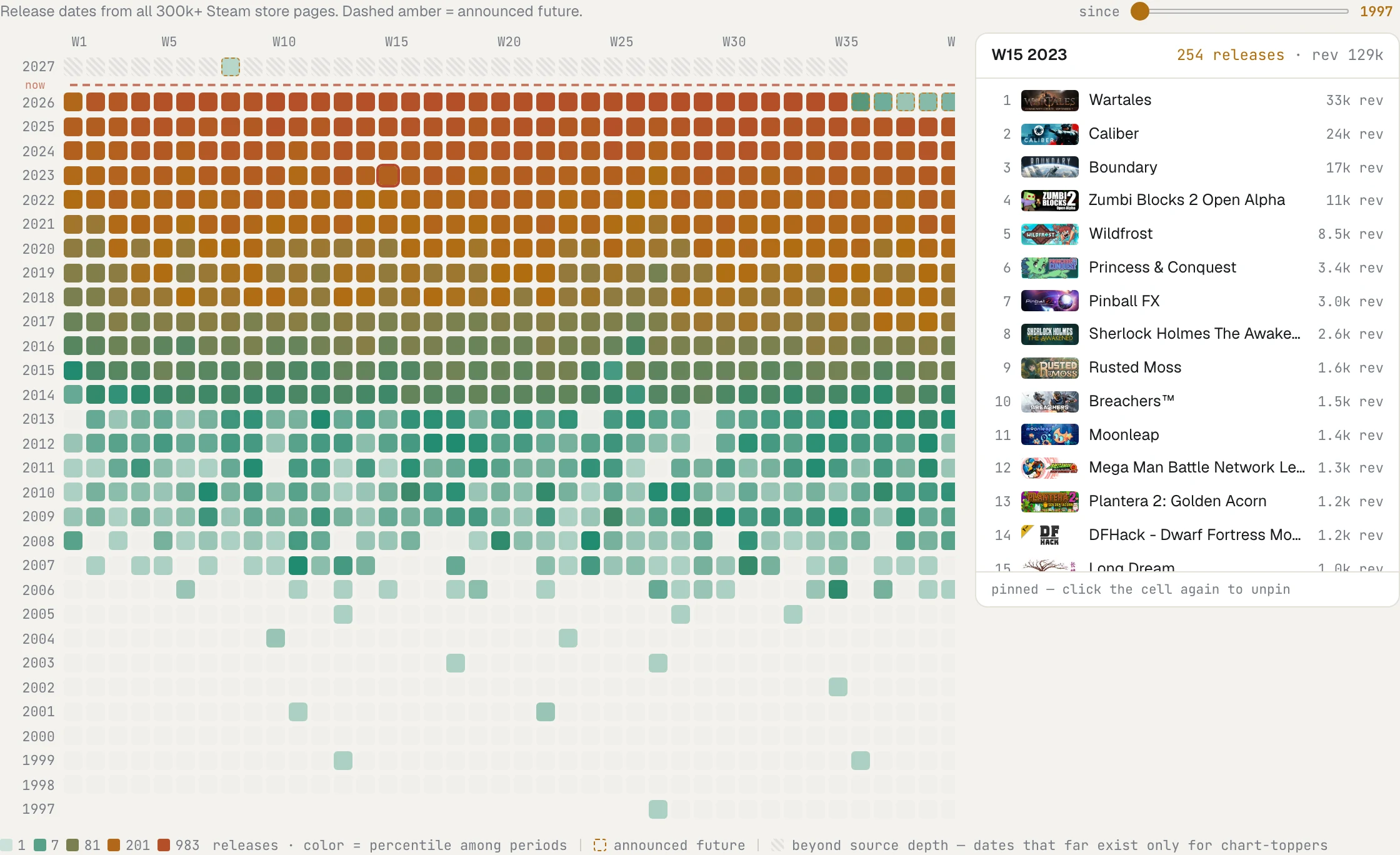
- Days or Weeks — daily cells cover the recent two years; weekly cells go back to 1997.
- Count or Calibre — Count colors cells by how many games shipped; Calibre weighs them by traction (reviews for the past, followers for announced games), so one heavyweight lights a cell up.
- Hover a cell to see the period's top-20 in the side panel; click to pin it. Each entry links to the game.
- Mind the hatched area. Far-future cells only contain chart-toppers — emptiness there does not mean the window will stay free.
Seasonality
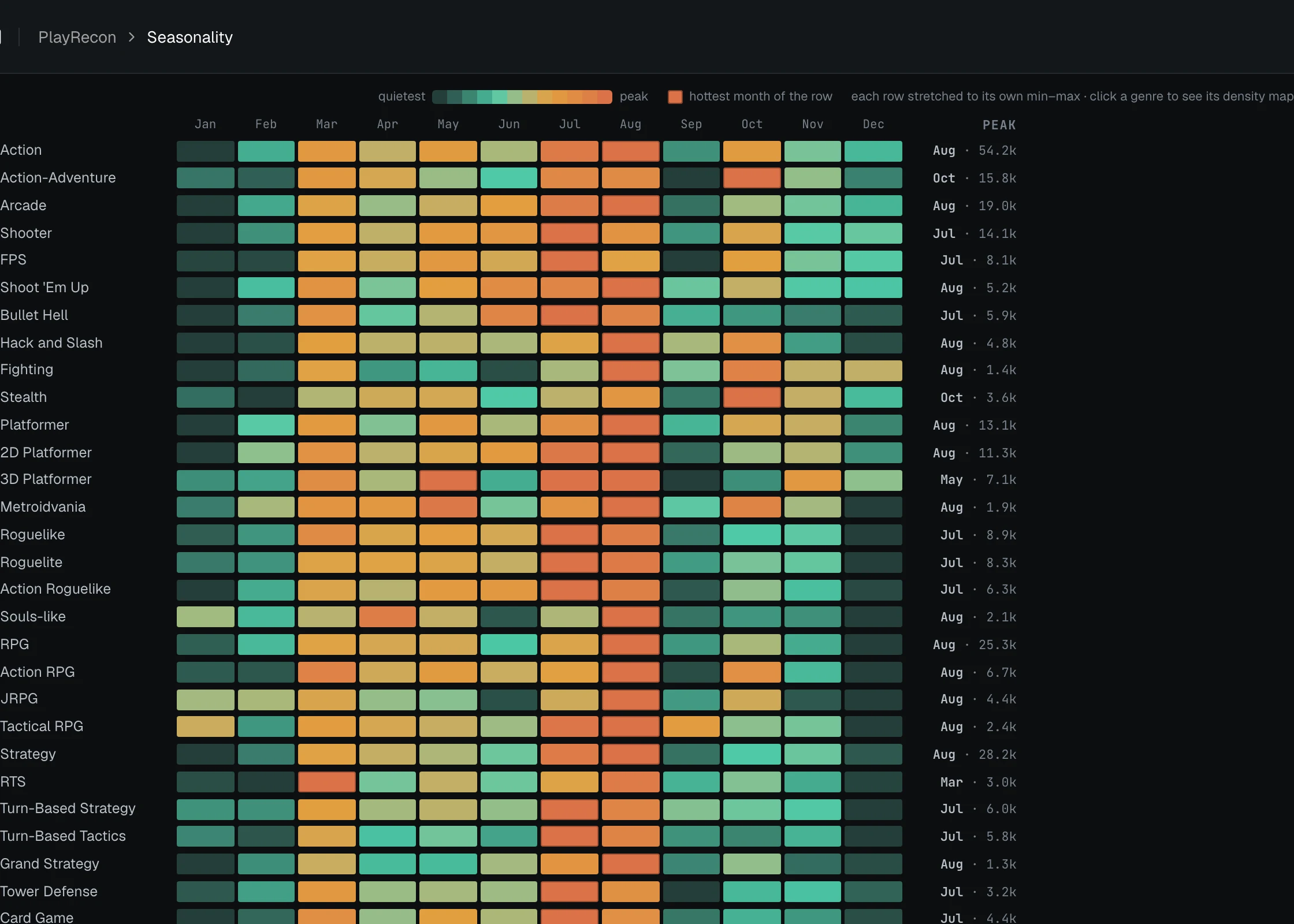
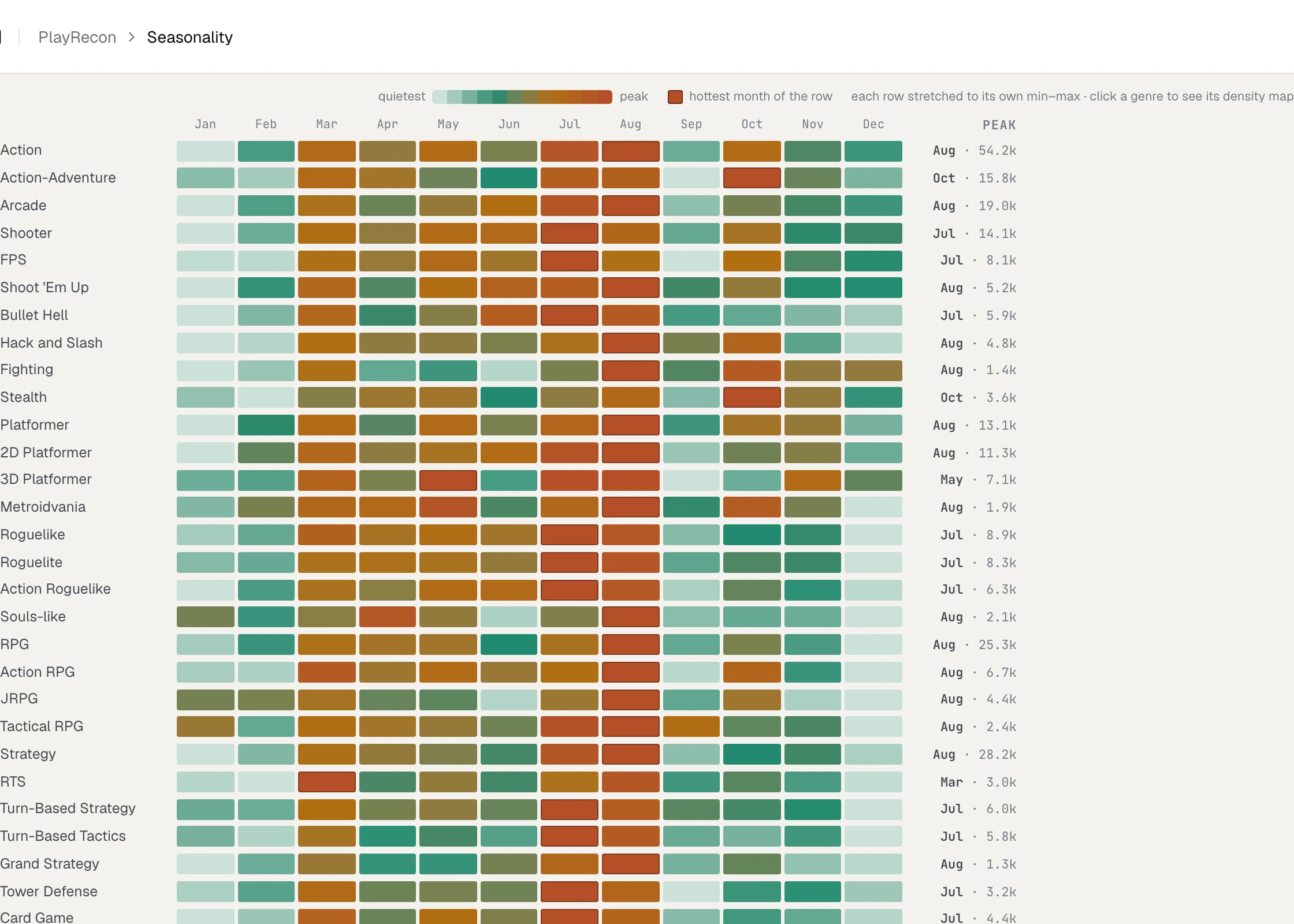
Shows when each genre actually ships and how those months perform, so you can tell a genuinely quiet month from one that is quiet for a reason.
Trends
The macro view: how fast the market grows, what a release gets on average, how many Steam users there are per release, and which tags rise or fade.
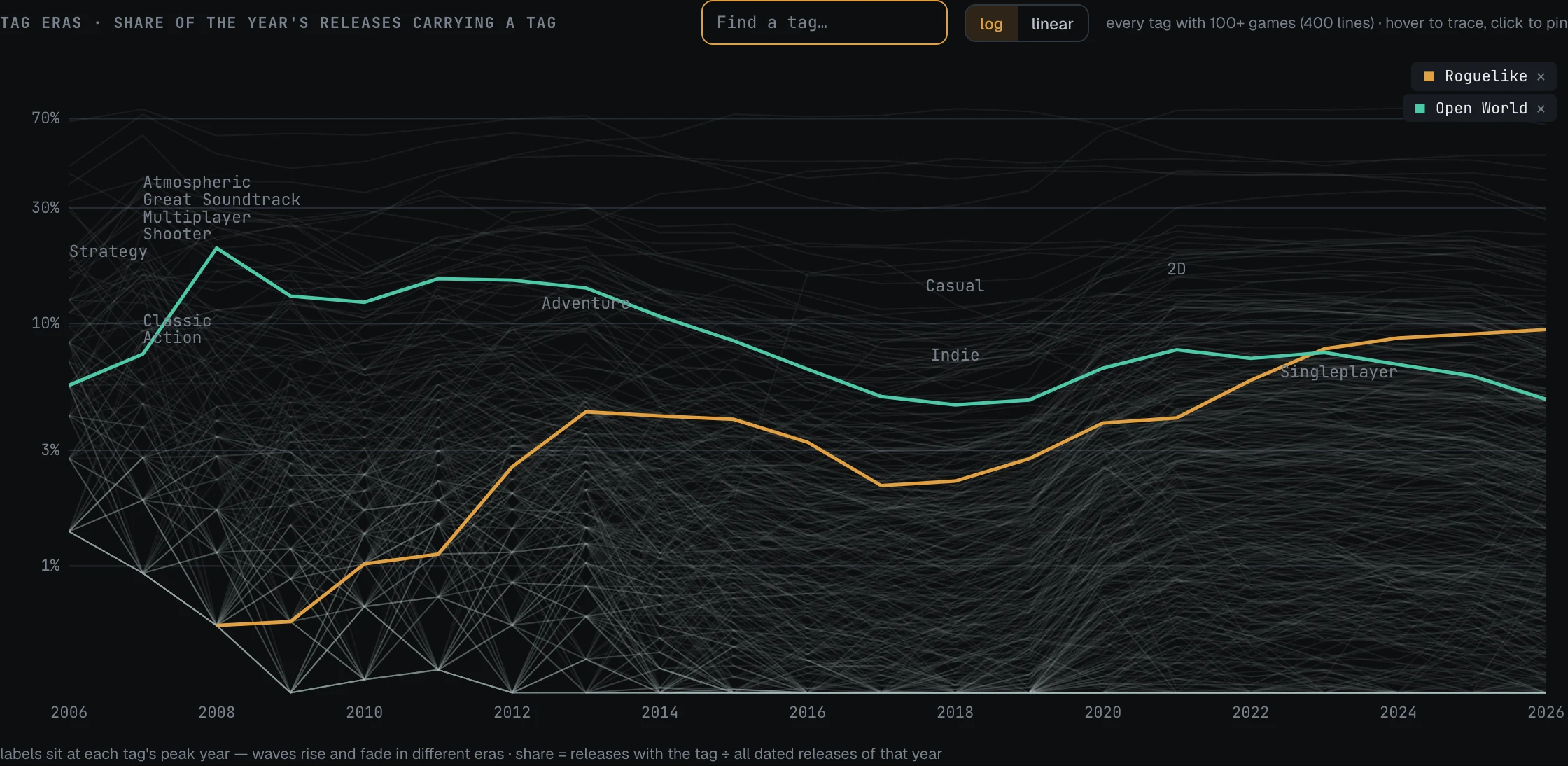
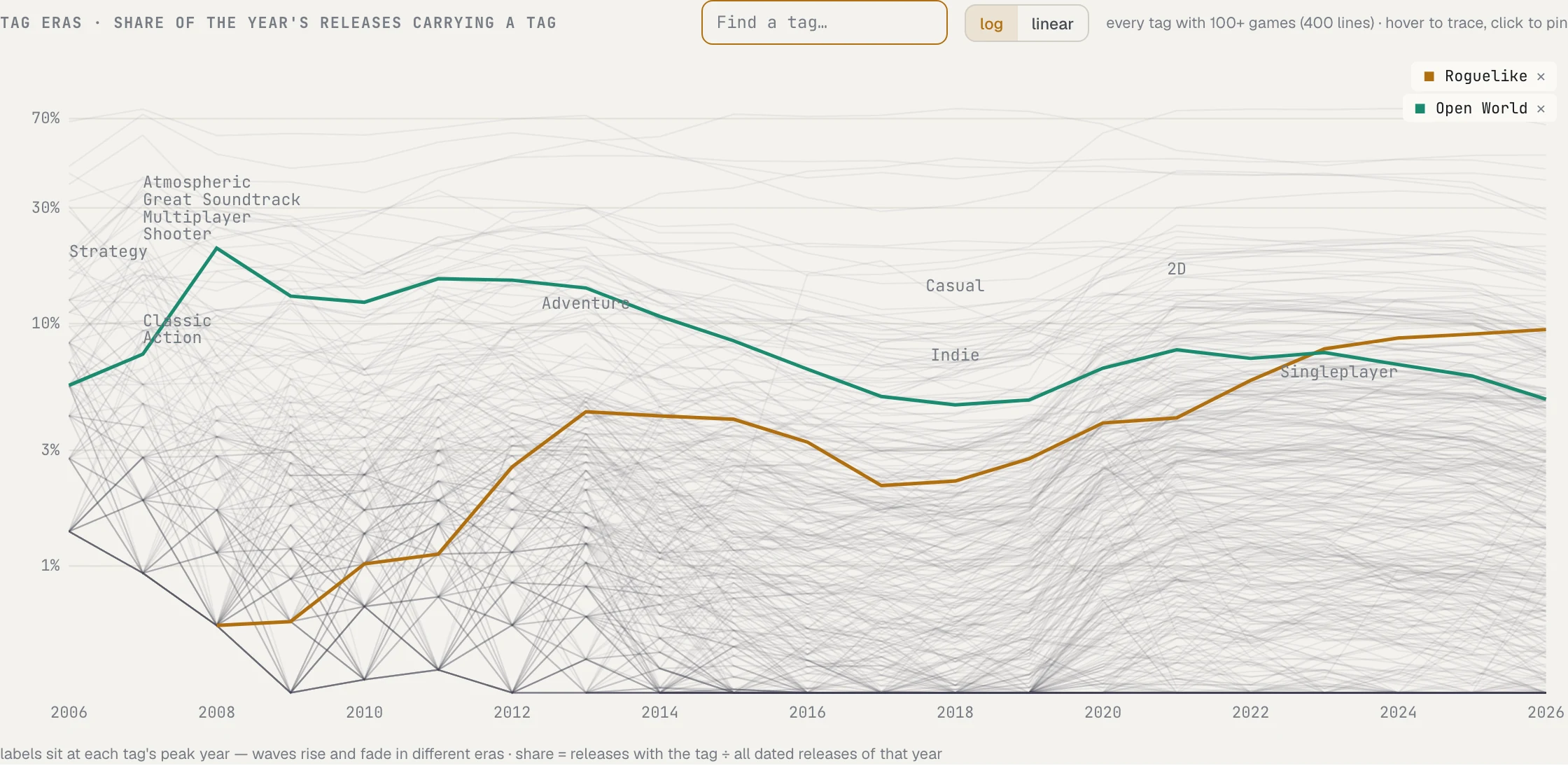
- Growth — releases per year with yearly change, plus weekday and month patterns. Filter by genre to see your market, not the whole store.
- Steam users per release — yearly peak online users divided by dated releases: one line that shows how competition tightened.
- Tag eras — use the log scale to compare small tags; labels sit at each tag's peak year.
Studios
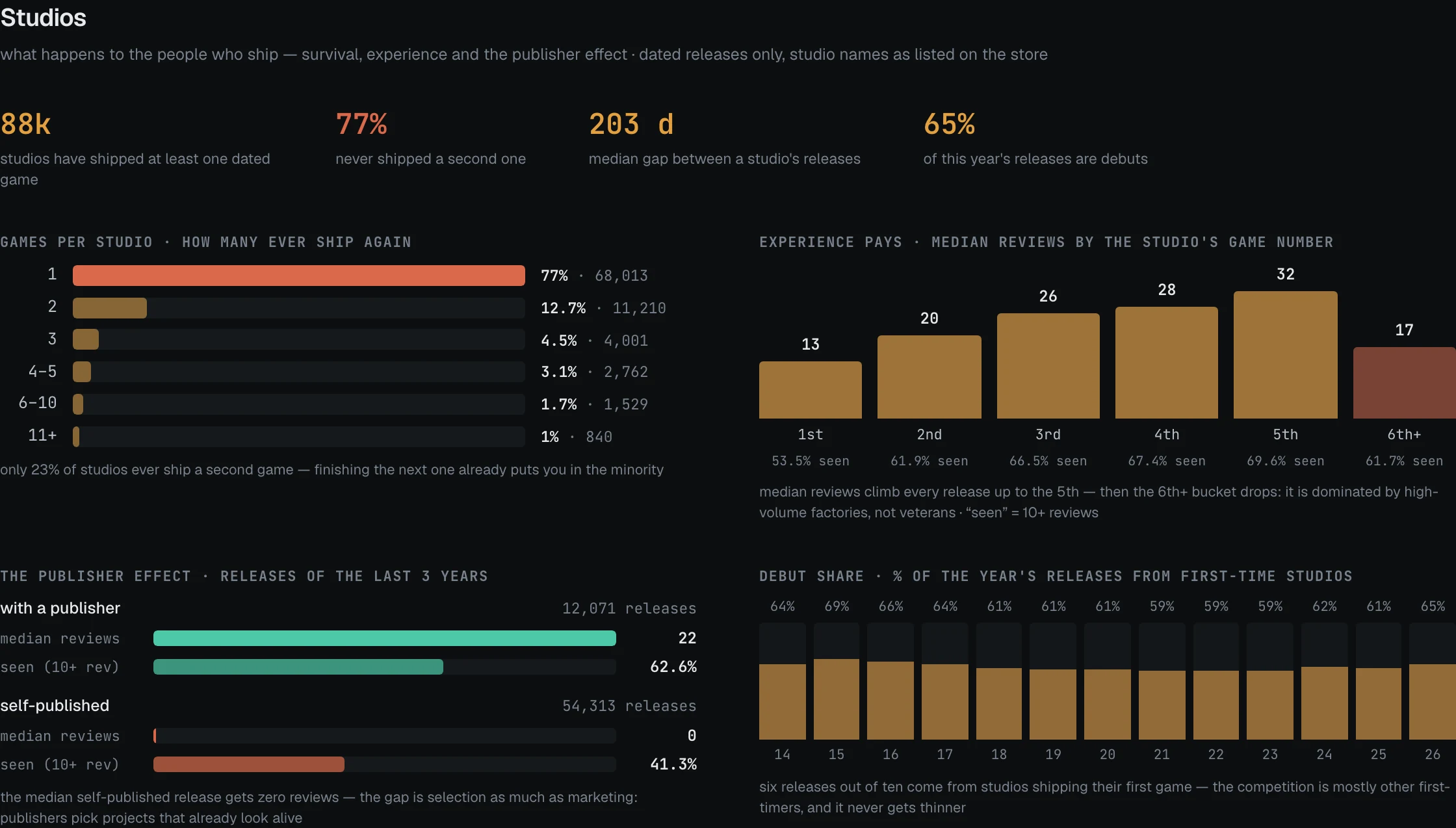
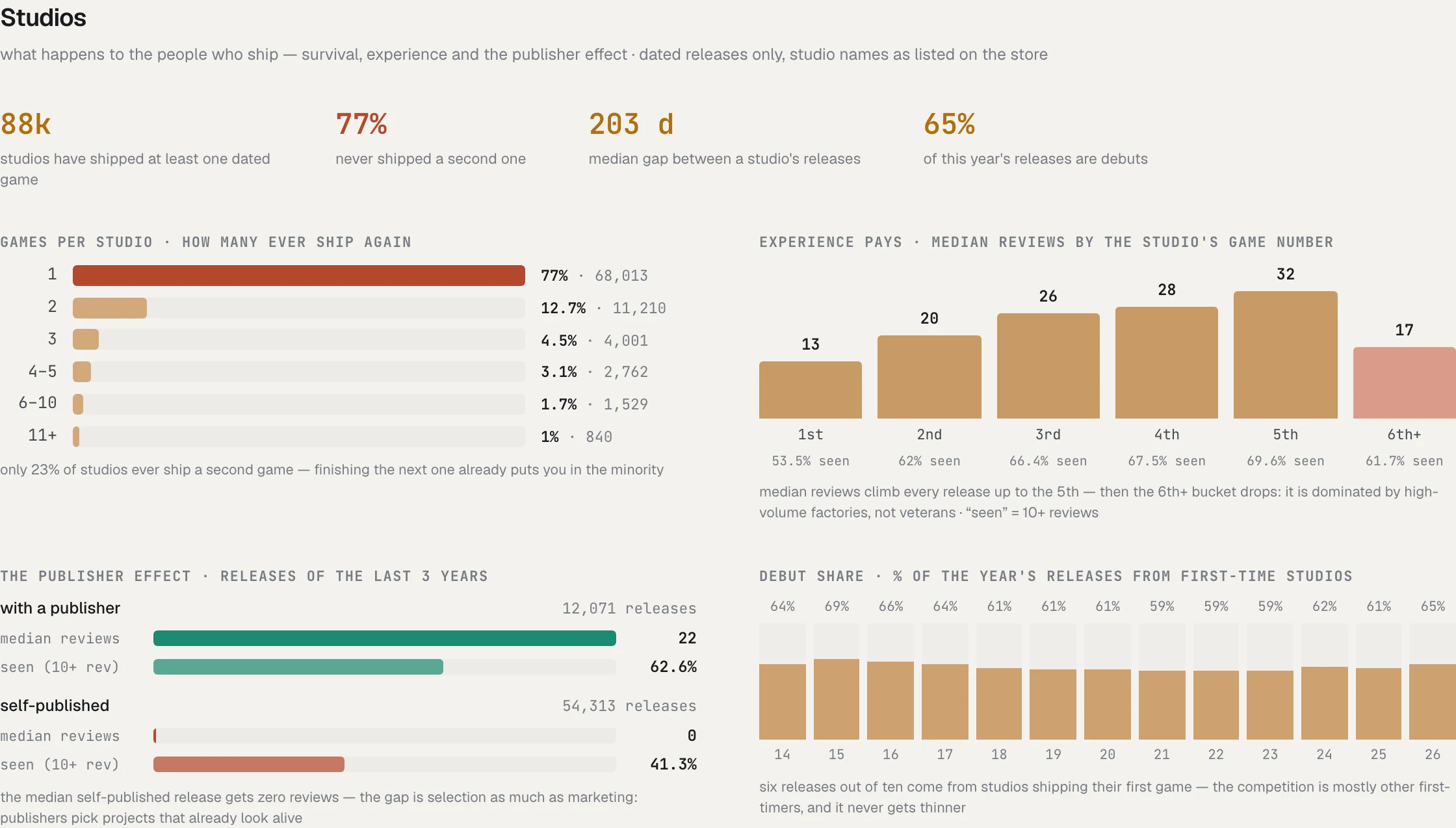
What happens to the people who ship: how many studios ever release a second game, whether experience pays, and what a publisher changes.
Window Finder
Recommends release windows for your game: give it your genre and constraints, and it scores every candidate window by crowding and collisions with heavyweight releases.
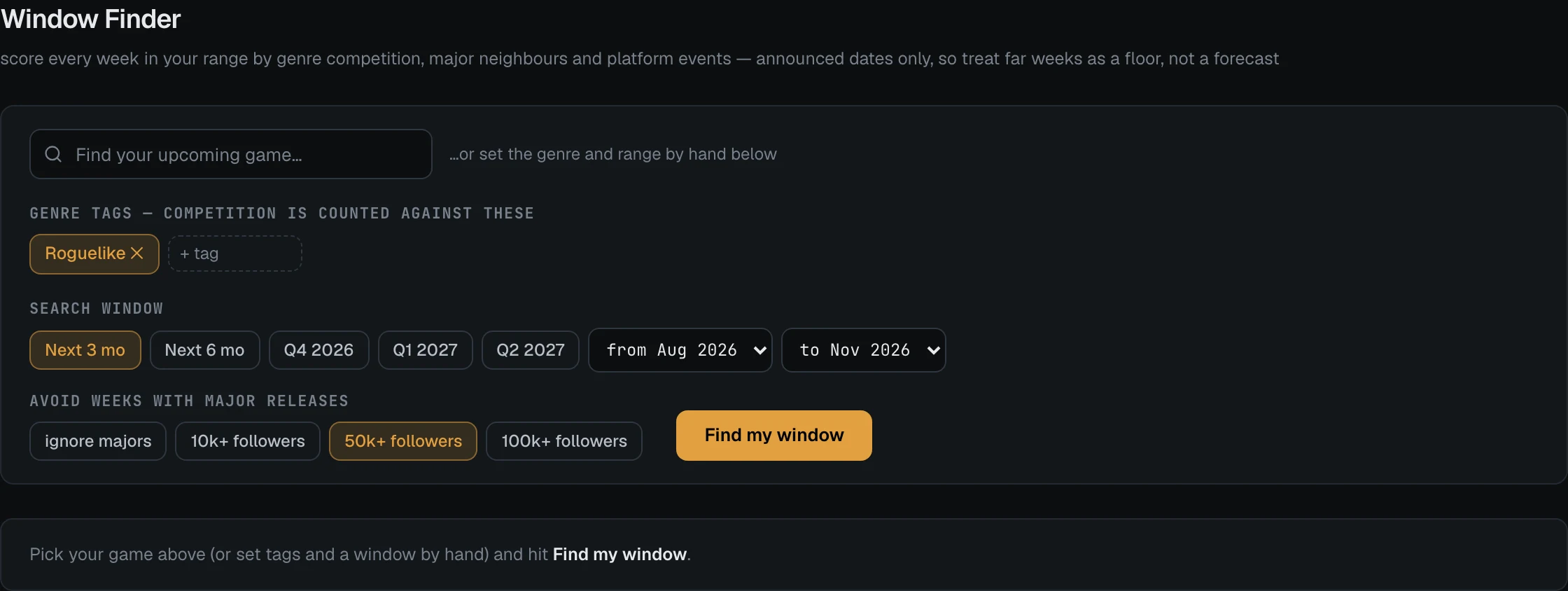
- Pick your genre tags (up to ten) — crowding is computed against games that share them, not the whole store.
- Constrain the range if your dates are already boxed in — a quarter, a month, anything.
- Set the heavyweight threshold — the follower count above which a neighbouring release counts as a collision to avoid.
- Attach your game via search to keep the context while you compare windows.
Metrics
The same few metrics appear across every tool. All of them come straight from Steam surfaces — nothing is modelled unless labelled as an estimate.
| PU # | Position in Steam’s Popular Upcoming chart. Ranks are dynamic, so for released games it is the peak position reached; the ·Nd suffix is how many days the game held a chart spot. Steam keeps no archive of the chart, so we have a rank only for games whose run overlaps our recording — releases from before it have none, and their period pages omit the row instead of showing a zero. |
| WL # | Global wishlist rank on Steam. For released games it is the best position reached before release. Recorded live for the same reason as the Popular Upcoming rank: Steam publishes the standing, not its history. |
| Followers | Followers of the game’s Steam community hub — the broadest publicly visible demand signal, and the only one Steam shows for every page. |
| Score | A composite used for mosaic tile area, not a Steam metric: followers on a power-law scale with a boost for days spent in the Popular Upcoming chart. Games released before rank tracking began use reviews as a proxy for followers. |
| Reviews | Total review count on the store page. The standard scale proxy for released games: Steam does not publish sales, and reviews track them at a roughly stable ratio within a niche. |
| Demo | The game has a demo on Steam; the number beside the icon is the demo’s peak concurrent players. |
| Dud | A released game whose lifetime review count stayed under 10. Used as the failure share of a niche: it counts the releases that got no visible traction at all, and it is included in every distribution on purpose — a niche looks better than it is if failures are dropped. |
| Unseen | A release with no followers, no wishlist rank and no time on the Popular Upcoming chart. Not the same as a failure: it means Steam’s public surfaces never showed the game, so nothing can be said about its demand either way. |
| Data as of | The date of the data snapshot every number on the page is built from. Store pages are re-read hourly; the date shows when the visible aggregate was last rebuilt. |
Full definitions, including which numbers are Steam’s and which are ours, are on Metrics and definitions.
Data
Coverage and freshness — what the numbers are built on and where the edges are.
- Release dates, tags, prices, reviews and followers come from Steam store pages — all 300k+ of them. Data refreshes hourly; the sidebar footer shows the snapshot date.
- Popular Upcoming and wishlist ranks have been tracked continuously since July 2026. Games released earlier have no rank history, so demand for them falls back to reviews.
- Calendar history reaches back to 1997 — as far as Steam store pages carry dated releases. Far-future coverage is limited to chart-toppers: precise dates usually appear two to four weeks before release.
- Questions or something looks off? Write to [email protected].