
Marketing beats
What a release date announcement, a demo, a video, a discount or a major update typically does for games in a genre, against weeks when nothing happened. Use it to decide which beats a campaign needs and what to expect from each.
Open Marketing beats →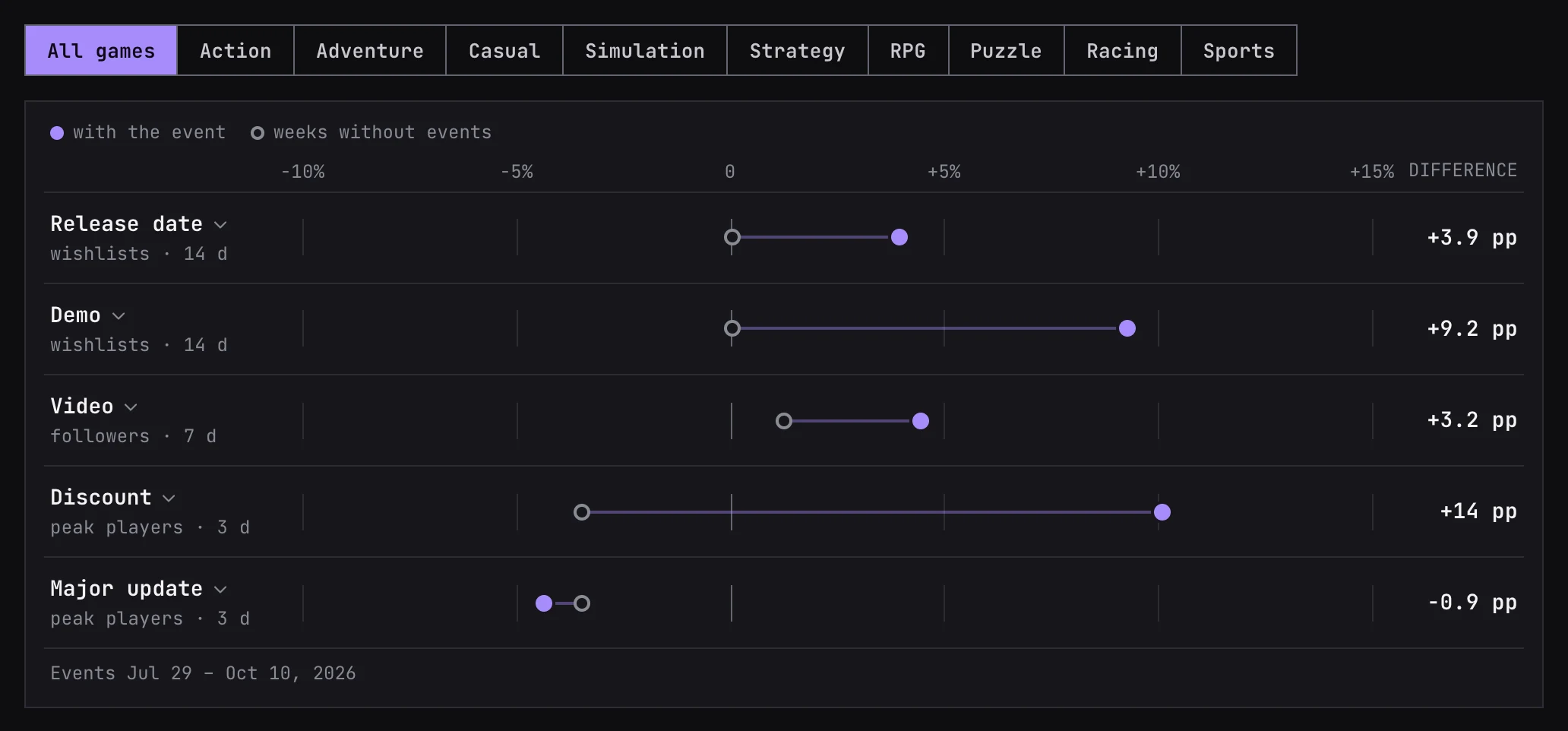
- Pick a genre. All games by default, or one base genre: Action, Adventure, Casual, Simulation, Strategy, RPG, Puzzle, Racing, Sports. The link keeps the choice.
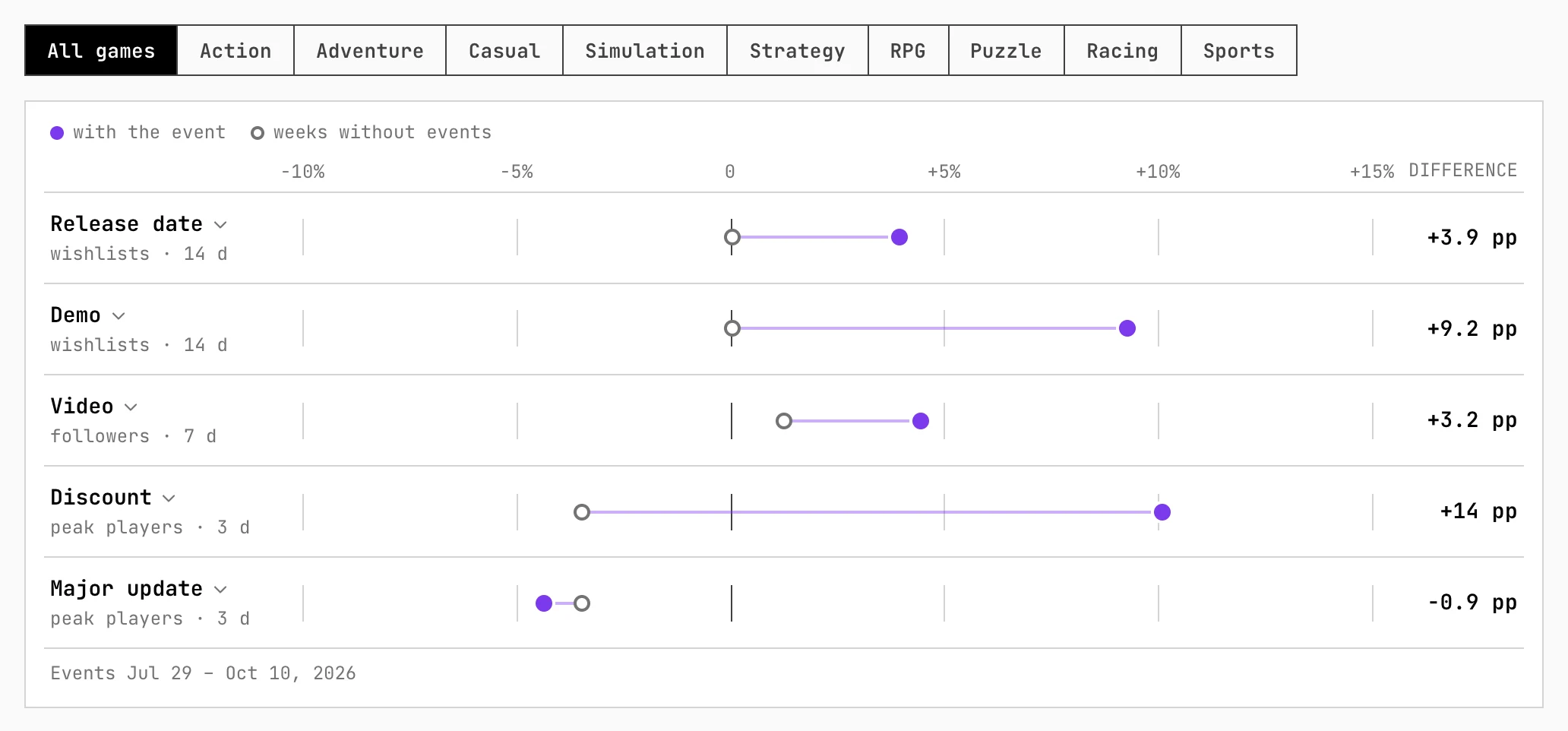
- Read a row. The filled dot is the typical change after the event, the hollow dot the change over the same days without any event, and the column on the right is the gap between them in percentage points. Each event is measured on what it moves first: wishlist rank after a release date and a demo, followers after a video, peak players after a discount and an update.
- Click a row for the details: several time windows, the middle half of the cases, how often the number went up with and without the event, and how many events were counted.
- Too few events. A genre with fewer than 30 events of a kind gets no norm, and the row says how many there were.
Worth knowing
- Every event counts, including those followed by nothing, so a row shows what usually happens, not what a strong campaign gets.
- Wishlists are read from the Top Wishlists rank, not from wishlist counts: the change is how much closer to the top the game moved. Peak players count only for games with 20+ online.
- A coincidence in time is not proof of cause. Big updates tend to ship while players are already leaving, so a drop in the week after one is the game’s trend, not harm from the update.
- Steam Next Fest and showcases are not measured yet.